Are rising AI costs preventing your organization from adopting large language models at scale? This article explains how to make a LLM Cost Optimization strategy practical, scalable, and aligned with business outcomes.
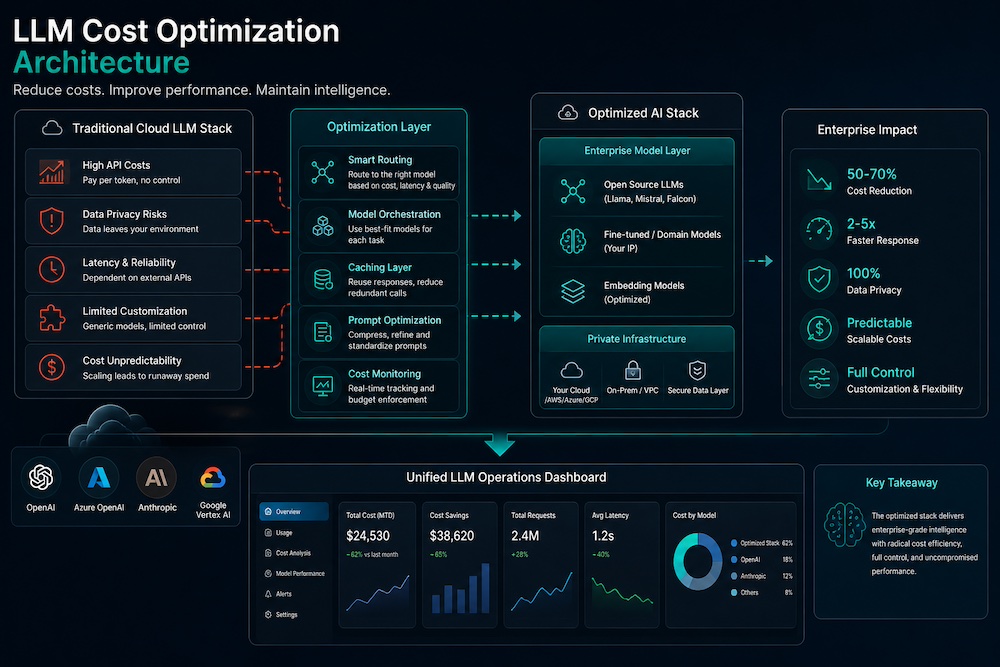
Many enterprises want to leverage an LLM for automation, customer engagement, and analytics. However, cost remains a major barrier. Infrastructure, model training, API usage, and governance often create unexpected expenses.
Moreover, organizations pursuing digital transformation frequently struggle to balance innovation with operational efficiency. While AI adoption grows rapidly, many leaders remain cautious about long-term financial sustainability.
According to McKinsey, generative AI could add trillions of dollars annually to the global economy. However, implementation costs still prevent many businesses from scaling confidently.
Therefore, understanding LLM Cost Optimization becomes essential for organizations seeking business value without excessive investment.
Common Challenges Businesses Face
Businesses often assume AI adoption only requires selecting a model. However, the reality is far more complex.
Many organizations underestimate the operational expenses behind an LLM deployment. Consequently, projects may stall after initial experimentation.
1. High Infrastructure Costs
Training and running language models demand significant computing resources. GPUs, cloud services, and storage can quickly increase monthly spending.
Additionally, scaling usage across departments multiplies infrastructure demands.
2. Poor Model Selection
Some companies adopt oversized models for simple use cases. As a result, they pay more than necessary.
Not every workflow requires a large, highly complex model.
3. Uncontrolled API Consumption
API-based models simplify adoption. However, excessive requests can create unpredictable billing.
Without monitoring, usage costs often rise rapidly.
4. Limited Governance and Monitoring
AI solutions require visibility into performance and spending.
Unfortunately, many teams lack measurement frameworks.
This creates inefficiency and prevents optimization.
5. Lack of Clear Business Alignment
Organizations sometimes implement AI without identifying measurable outcomes.
Consequently, investment grows without clear ROI.
How LLM Cost Optimization Solves This
LLM Cost Optimization focuses on improving efficiency while maintaining model quality.
Rather than reducing capability, optimization ensures smarter allocation of AI resources.
This approach helps businesses achieve better value from their AI investments.
Choose the Right Model Size
A smaller model often performs effectively for focused business tasks.
For example, internal support workflows may not require enterprise-scale generative models.
Therefore, selecting the appropriate model size reduces infrastructure costs.
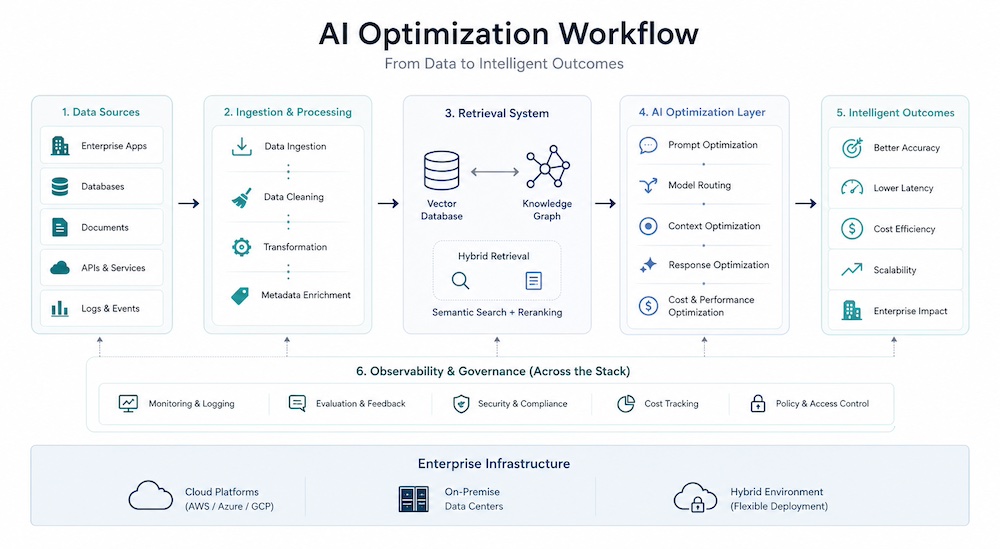
Use Retrieval-Augmented Generation (RAG)
RAG allows models to access external knowledge bases instead of memorizing everything.
As a result, businesses can use lighter models with strong contextual responses.
Additionally, accuracy improves through updated data retrieval.
Fine-Tune Instead of Training From Scratch
Training an LLM from the ground up is expensive.
Fine-tuning an existing model significantly reduces development effort.
Moreover, fine-tuning shortens deployment timelines.
Implement Token Management
Every prompt generates tokens. Therefore, prompt design affects cost directly.
Businesses can reduce expenses by limiting unnecessary context.
Prompt engineering also improves efficiency.
Leverage Hybrid Deployment Models
Organizations can combine cloud and on-premise systems.
This hybrid strategy balances scalability and cost control.
Additionally, sensitive workloads may remain internal for governance reasons.
Key Benefits and ROI of Cost-Effective LLM Adoption
Businesses adopting structured optimization approaches often achieve measurable gains.
Lower Infrastructure Spending
Optimized AI environments reduce unnecessary compute usage.
Consequently, organizations control operating costs more effectively.
Faster Deployment Timelines
Pre-trained models and fine-tuning accelerate implementation.
Therefore, businesses launch AI solutions faster.
Improved Business Scalability
Cost-efficient architectures support broader adoption.
Teams can scale AI across customer service, operations, and analytics.
Better Resource Allocation
Organizations redirect budgets toward innovation instead of infrastructure waste.
This strengthens overall transformation strategy.
Higher Return on Investment
According to Deloitte, enterprises implementing AI strategically achieve up to 20–30% productivity gains.
Additionally, optimized AI reduces operational bottlenecks.
Direct Business Outcomes
A cost-effective LLM can support:
- Customer service automation
- Intelligent document processing
- Internal knowledge management
- Workflow acceleration
- Sales and marketing automation
These outcomes improve efficiency while supporting growth.
Real-World Use Case or Scenario
Consider a mid-sized enterprise handling thousands of customer inquiries monthly.
Initially, the company used a large API-driven language model.
Although response quality remained high, monthly costs increased rapidly.
Therefore, the organization reviewed its architecture.
The Challenge
- High token usage
- Growing API bills
- Delayed response times
- Lack of contextual business knowledge
The Solution
The company implemented LLM Cost Optimization using a retrieval-based architecture.
Additionally, they fine-tuned a smaller open-source model.
A business knowledge base was integrated into the workflow.
The Outcome
- AI response cost reduced by nearly 45%
- Faster response generation
- Better domain-specific accuracy
- Improved user satisfaction
According to Gartner, by 2027, over 50% of generative AI deployments will include retrieval augmentation.
This trend highlights the importance of smarter architecture.
How to Get Started With LLM Cost Optimization
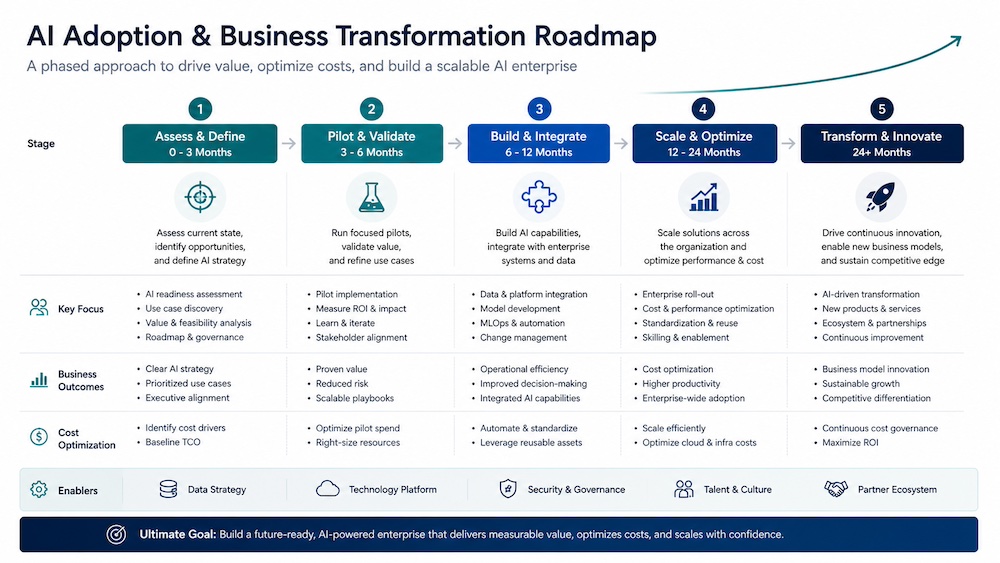
Many organizations delay implementation because they assume AI requires large budgets.
However, a phased approach reduces complexity.
Step 1: Identify High-Value Use Cases
Begin with workflows that deliver measurable impact.
Examples include:
- Customer support automation
- Employee knowledge search
- Sales enablement assistants
- Compliance documentation analysis
Step 2: Define Business Outcomes
Clarify expected value before selecting a model.
For example, define whether the goal is speed, automation, or personalization.
Step 3: Select an Appropriate Model
Not every use case requires a massive LLM.
Smaller models may provide better cost efficiency.
Step 4: Implement Monitoring
Track usage, latency, and performance metrics.
Monitoring prevents overspending and supports continuous optimization.
Step 5: Build for Scale
Plan for future expansion early.
Additionally, integrate governance frameworks from the beginning.
Additional Technologies That Support LLM Cost Optimization
Several supporting technologies improve AI affordability.
Edge AI Processing
Edge deployment reduces dependency on cloud inference.
Consequently, latency decreases while cost improves.
Containerized AI Deployment
Containers improve portability and resource efficiency.
Therefore, deployment becomes easier across environments.
Knowledge Graph Integration
Knowledge graphs provide structured context.
This reduces hallucinations and improves response quality.
IoT Data Integration
Organizations integrating IoT systems gain contextual insights.
AI models can interpret device data intelligently.
Mobile AI Applications
AI-powered mobile experiences continue expanding.
Therefore, businesses increasingly combine Development of AI Apps with mobile-first strategies.
Conclusion
AI adoption continues accelerating across industries. However, cost remains a major concern.
Organizations that optimize early gain stronger scalability and lower risk.
A well-designed LLM strategy supports both operational efficiency and innovation.
Moreover, businesses no longer need massive budgets to implement meaningful AI solutions.
The key lies in choosing the right architecture, monitoring usage, and aligning technology with measurable outcomes.
Let’s Discuss How This Can Work for Your Business
If you are exploring AI adoption, cost should not become a barrier to innovation.
At Fusion Informatics, we help organizations design scalable AI ecosystems aligned with business priorities.
Our services include:
- AI solution development
- Intelligent automation platforms
- Mobile app development
- IoT solution integration
- End-to-end digital transformation strategy
If your organization is planning AI adoption, the real challenge is not technology. Execution matters more.
Let’s discuss how cost-effective AI, mobile, and IoT solutions can be applied to your business goals.
A discovery discussion often reveals faster opportunities than expected.
Frequently Asked Questions
- What is an LLM?
An LLM is a large language model trained to understand and generate human language. - Why is LLM Cost Optimization important?
Optimization reduces infrastructure, API, and operational expenses while improving scalability. - Can smaller models perform well?
Yes. Smaller models often work effectively for focused business tasks. - Is training from scratch necessary?
No. Fine-tuning existing models usually delivers faster and more affordable results. - Which industries benefit most from LLM adoption?
Healthcare, finance, manufacturing, retail, logistics, and education benefit significantly.
Quick Summary
Cost-effective AI requires architectural planning LLM Cost Optimization reduces unnecessary spending Fine-tuning often outperforms full model training Smaller models can support focused business goals Monitoring ensures sustainable AI growth Retrieval systems improve accuracy and affordability AI adoption works best when aligned with business outcomes