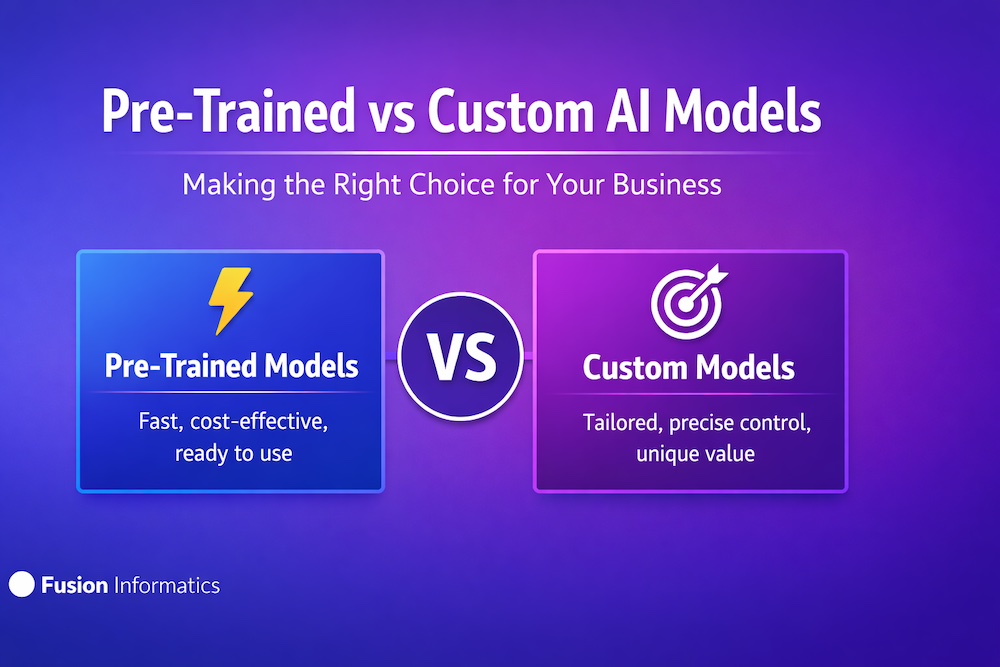
Choosing between Pre-Trained vs Custom AI Models can feel overwhelming. Every business leader faces this decision today. The artificial intelligence landscape offers multiple pathways. However, selecting the right approach determines your project’s success. Pre-Trained vs Custom AI Models each bring distinct advantages. Your choice impacts budget, timeline, and outcomes. Therefore, understanding both options becomes crucial. This guide helps you make an informed decision. Moreover, it explores real-world applications and considerations.
Understanding Pre-Trained AI Models
Pre-trained models come ready to use. They’ve learned from massive datasets already. Consequently, they save significant development time. Companies like OpenAI and Google provide these models. They handle common tasks effectively. For instance, text analysis works brilliantly. Image recognition also performs well. Additionally, translation features come built-in.
Furthermore, these models require minimal setup. You can integrate them quickly. Your team doesn’t need extensive AI expertise. This accessibility makes them attractive. Small businesses particularly benefit from this approach. Budget constraints become less challenging. Nevertheless, customization options remain limited.
The Power of Custom AI Models
Custom models solve specific problems. They’re built for your unique needs. Ashesh Shah from Fusion Informatics often emphasizes this point. Tailored solutions deliver better results. Your business requirements drive the development. Subsequently, the model understands your domain deeply.
Moreover, custom development offers complete control. You decide the training data. Features align with your objectives. The Development of AI Apps becomes more precise. However, this path demands more resources. Time investment increases significantly. Expert teams become necessary. Budget requirements grow accordingly.
Pre-Trained vs Custom AI Models: Cost Considerations
Budget plays a critical role. Pre-trained models cost less upfront. Monthly subscriptions remain affordable. Meanwhile, custom solutions require substantial investment. Development teams charge premium rates. Training infrastructure adds expenses. Data collection also costs money.
However, long-term value differs greatly. Pre-trained models have ongoing fees. Custom models become your asset. Therefore, calculate total ownership costs. Consider your timeline carefully. Short-term projects favor pre-trained options. Long-term initiatives benefit from custom development.
Additionally, maintenance costs vary significantly. Pre-trained models handle updates automatically. Custom solutions need continuous monitoring. Your team must manage improvements. Bug fixes require dedicated resources. Security updates demand attention too.
Performance and Accuracy Factors
Accuracy determines AI success. Pre-trained models perform well generally. They excel at common tasks. Nevertheless, niche applications suffer sometimes. Generic training data limits specificity. Your unique requirements might not fit.
Conversely, custom models target your exact needs. They learn from your specific data. Consequently, accuracy improves dramatically. Industry-specific terminology gets recognized better. Edge cases receive proper handling. The Development of AI Apps benefits from this precision.
Furthermore, performance optimization becomes possible. You control the model architecture. Resource allocation matches your requirements. Speed improvements can be prioritized. Efficiency gains multiply over time.
Time to Market Analysis
Speed matters in business. Pre-trained models launch quickly. Integration takes days, not months. Your team implements solutions rapidly. Therefore, market opportunities get captured faster. Competitive advantages emerge sooner.
In contrast, custom development takes longer. Building from scratch requires patience. Data collection consumes considerable time. Training phases extend timelines further. Testing and refinement add more weeks. However, the final product fits perfectly.
Moreover, iterative improvements differ substantially. Pre-trained models update on the provider’s schedule. You can’t control enhancement timing. Custom solutions evolve at your pace. Updates happen when you need them. Strategic alignment becomes easier to maintain.
Pre-Trained vs Custom AI Models: Scalability Perspectives
Growth plans influence model selection. Pre-trained solutions scale automatically. Providers handle infrastructure expansion. Your usage simply increases gradually. Billing adjusts accordingly. Technical complexity remains manageable.
Meanwhile, custom models require planning. Scaling needs careful architecture design. Infrastructure must be provisioned appropriately. The Development of AI Apps demands foresight. Load balancing becomes your responsibility. Performance monitoring requires constant attention.
However, custom solutions offer better control. You optimize for your growth pattern. Resources get allocated efficiently. Unexpected spikes can be managed. Cost predictability improves over time.
Data Privacy and Security
Sensitive data needs protection. Pre-trained models process data externally. Information travels to third-party servers. This raises privacy concerns naturally. Compliance requirements might get violated. Regulatory issues could arise unexpectedly.
Conversely, custom models stay in-house. Your data never leaves your infrastructure. Complete control ensures better security. Compliance becomes easier to maintain. Ashesh Shah regularly advises clients on this aspect. Fusion Informatics prioritizes data protection always.
Additionally, custom solutions allow security customization. Encryption methods match your standards. Access controls reflect your policies. Audit trails follow your requirements. Therefore, sensitive industries prefer this approach.
Industry-Specific Requirements
Different sectors have unique needs. Healthcare demands strict compliance. Financial services require robust security. Manufacturing needs real-time processing. Retail wants personalization capabilities. Each industry presents distinct challenges.
Pre-trained models work for general applications. Customer service chatbots perform adequately. Basic content generation succeeds reasonably. Standard image recognition functions properly. However, specialized tasks need customization.
Furthermore, domain expertise becomes invaluable. Medical diagnosis requires specific training. Legal document analysis needs specialized knowledge. Financial forecasting demands particular data. Custom models incorporate this expertise effectively.
Integration and Compatibility
Existing systems matter significantly. Pre-trained models offer standard APIs. Integration becomes relatively straightforward. Documentation usually exists abundantly. Community support helps troubleshooting. Therefore, technical barriers remain low.
However, legacy systems pose challenges. Custom models integrate more smoothly sometimes. They’re designed for your environment specifically. Compatibility issues get addressed early. The Development of AI Apps considers your tech stack.
Moreover, future flexibility differs considerably. Pre-trained solutions depend on provider roadmaps. Feature additions follow their schedule. Custom development puts you in control. New capabilities get added when needed.
Making the Right Choice
Several factors guide your decision. Budget constraints cannot be ignored. Timeline pressures demand consideration. Technical capabilities matter significantly. Business objectives drive everything ultimately.
Start by defining your requirements clearly. List essential features precisely. Identify nice-to-have capabilities separately. Evaluate available resources honestly. Consider both immediate and future needs.
Additionally, hybrid approaches work sometimes. Start with pre-trained models initially. Validate your concept quickly. Gather user feedback rapidly. Then migrate to custom solutions gradually. This strategy minimizes risk effectively.
The Fusion Informatics Approach
Ashesh Shah brings extensive experience. Fusion Informatics has guided numerous clients. Their methodology balances practicality with innovation. Assessment begins with understanding objectives. Technical evaluation follows comprehensive business analysis.
Furthermore, they recommend phased implementations. Quick wins build momentum initially. Complex customizations happen later strategically. This approach manages risk while delivering value. Client success remains the primary focus always.
Pre-Trained vs Custom AI Models: Future Trends
Technology evolves continuously. Pre-trained models become more capable. Customization options expand gradually. Fine-tuning becomes easier over time. Therefore, the gap narrows somewhat.
However, unique business needs persist. Competitive differentiation requires customization. Proprietary advantages come from custom solutions. Innovation happens through tailored development. The Development of AI Apps will continue diversifying.
Moreover, hybrid solutions gain popularity. Combining both approaches makes sense. Pre-trained foundations get customized further. This balances cost with capability effectively.
Conclusion
The choice between Pre-Trained vs Custom AI Models depends on your specific situation. Budget, timeline, and requirements all matter equally. Pre-trained models offer quick, affordable solutions. Custom development delivers precision and control. Evaluate your needs carefully before deciding.
Remember, there’s no universal right answer. Your business context determines the best path. Consider both short-term and long-term implications. Consult with experts like those at Fusion Informatics. Make an informed decision that supports your goals.
Ultimately, successful AI implementation requires strategic thinking. Choose the approach that aligns with your vision. Execute with dedication and expertise. The rewards will justify your investment.